
Mezzo
Buy This Album


Share This Album


“While both Tim Garland and Geoffrey Keezer are at the top of their game as soloists on their respective instruments, the real genius of this collaboration shines in their choice of the duet format. As they carry on improvisational one-on-one conversations, every chord, every fragment of melody just fits perfectly from start to finish on every track of this record. This just may be the best jazz duet I have ever heard.”
GARY BURTON
“Tim Garland and Geoff Keezer create some beautiful duet explorations that are inspired and inspiring. The oneness of their communication and execution is magical. Bravo !”
JOE LOVANO
These two Grammy-winning artists have known each other for twenty-five years and worked notably as two thirds of the transatlantic Storms / Nocturnes Trio with US vibist Joe Locke.
Tim writes, “ most of my closest musical collaborators, mentors and inspirers have been piano players and Geoffrey’s ability to musically dialogue at lightning speed was always going to lead to some vibrant duetting. We use words like ‘breath-taking’ too lightly sometimes but listen to both the gorgeous harmonic inventions and his sheer rhythmic energy!”
Both musicians were mentored by legends of the jazz genre, Keezer playing with Art Blakey age 18 and Benny Golson and Ray Brown in his 20’s. After joining Ronnie Scott’s band at 23, Garland went on to work with Chick Corea over a 17-year period which introduced him to many other players from the US and beyond.
MEZZO was recorded in New York in a five hour session and is a testament by two seasoned maestros to the shared love of the powerful lyricism and deep interaction that duets can inspire.
Geoffrey writes, “I’ve enjoyed learning and performing Tim Garland’s music for nearly 25 years. Tim has carved out a unique and individual path in his composing and playing, drawing from the best of the musical worlds of classical, jazz and world genres, forging them into something wholly original. His music successfully and seamlessly merges fully notated passages with free improvisation (a.k.a. spontaneous composition). While Tim’s pieces can be technically challenging from a pianistic standpoint, the rewards are ALWAYS there. As I’ve said many times over the years, and will continue to say it, playing Tim’s music has made me a better musician! Performing his works in a duo setting, along with my own and those of celebrated composers Mulgrew Miller and Erik Satie, gives us the ultimate freedom to explore, create, play and have fun stretching every boundary we can.”
This is Tim’s first release where he does not play tenor saxophone. Instead, the rare mezzo-soprano sets the tone in seven out of the nine tracks. At present there are only twenty of these instruments in existence, Tim’s being number nineteen, (and Joe Lovano’s being number two). Pitched between a conventional soprano sax and an alto, the timbre can be mellow and plaintive like a cor anglais or powerful like a flugelhorn. Garland still employs its brilliant top register but particularly enjoyed writing for the mezzo’s specific range, highlighted in Out Of Towner, A Prayer At Winter, To The One Who Flies and The Waves Between. The key of Satie’s famous Gnossienne No.1 is also lowered in this haunting duet adaptation.
This will be the first time Chick Corea’s music has been recorded featuring the instrument too. As Gary Burton writes about La Fiesta:“Of course, I played that song a couple thousand times over the course of 40-some years with Chick. I think we recorded it three times, including your orchestral version, Tim. As I cued up the track I wondered how would I react to this after having it so ingrained in my memory? From bar one, it was fresh, intriguing, and totally different than my La Fiesta recall. It wasn’t even open to comparison. I was struck by how comfortable you both sound soaring through your solos. When playing a classic there are two viable options. One is to honour the original by sticking close to the classic interpretation, but it has to be done so well that it is flawless and capable of standing on its own. The other choice is to re-imagine it very differently, creating a fresh, surprising, version while avoiding the risk of coming off as different for the sake of being different. Your version is on a plane of its own genius.”
Both Garland and Keezer share a love of contemporary composition and it is perhaps the playful spontaneity (so loved by Chick), coupled with a certain classical rigour, that allows them to pull off such a well contrasted set.Such a fusion and wonderful absorption of knowledge from both the tradition of jazz and more contemporary harmonies is evident in Cole Porter’s Every Time We Say Goodbye, where Geoffrey’s introduction surprises, yearns and moves in equal measure, the whole track recorded just once with no rehearsal.
Geoffrey’s Ghost in the Photograph features Tim’s celebrated regular soprano sound along with Mulgrew Miller’s wonderful Carousel, Miller being another of Geoffrey’s long term heroes.
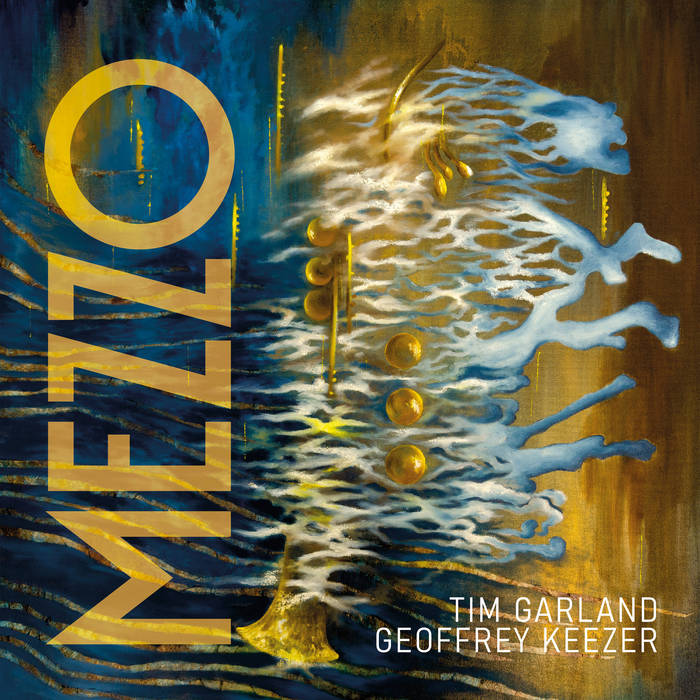
Garland’s folk-tinged The Waves Between is written after a painting of the same name by his partner Esra Kizir Gokcen, who seems to capture the mezzo (which means between) as it spills into our conscious world from subconscious depths. The random splashes she started with led to a horse-like image which, with its graceful power and agility, suits both this instrument and this recording very well.